

Terminology
Labels
Labels are a generic, flexible and highly scalable way of addressing a large set of resources as they allow for arbitrary grouping and creation of sets. Whenever something needs to be described, addressed or selected, it is done based on labels:
Endpoint are assigned labels derived from Kubernetes, Cilium-reserved identities, or other Cilium-managed sources.
Overview of Network Policy select pairs of Endpoint which are allowed to communicate based on labels. The policies themselves are identified by labels as well.
What is a Label?
A label is a pair of strings consisting of a key and value. A label can
be formatted as a single string with the format key=value. The key portion
is mandatory and must be unique. This is typically achieved by using the
reverse domain name notion, e.g. io.cilium.mykey=myvalue. The value portion
is optional and can be omitted, e.g. io.cilium.mykey.
Key names should typically consist of the character set [a-z0-9-.].
When using labels to select resources, both the key and the value must match,
e.g. when a policy should be applied to all endpoints with the label
my.corp.foo then the label my.corp.foo=bar will not match the
selector.
Label Source
A label can be derived from various sources. For example, an endpoint can derive labels from the Kubernetes pod associated with it. Different sources can use overlapping label keys.
To resolve this potential conflict, Cilium prefixes all label keys with
source: to indicate the source of the label when importing labels, e.g.
k8s:role=frontend. A Kubernetes pod started with the label foo: bar will
be represented with a Cilium endpoint associated with the label k8s:foo=bar.
A unique name is allocated for each potential source. The following label
sources are currently supported:
k8s:for labels derived from Kubernetesreserved:for special reserved labels, see Special Identities.unspec:for labels with unspecified source
When using labels to identify other resources, the source can be included to
limit matching of labels to a particular type. If no source is provided, the
label source defaults to any: which will match all labels regardless of
their source. If a source is provided, the source of the selecting and matching
labels need to match.
Endpoint
Cilium makes application containers available on the network by assigning them IP addresses. Multiple application containers can share the same IP address; a typical example for this model is a Kubernetes Pod. All application containers which share a common address are grouped together in what Cilium refers to as an endpoint.
Allocating individual IP addresses enables the use of the entire Layer 4 port
range by each endpoint. This essentially allows multiple application containers
running on the same cluster node to all bind to well known ports such as 80
without causing any conflicts.
The default behavior of Cilium is to assign both an IPv6 and IPv4 address to
every endpoint. However, this behavior can be configured to only allocate an
IPv6 address with the --enable-ipv4=false option. If both an IPv6 and IPv4
address are assigned, either address can be used to reach the endpoint. The
same behavior will apply with regard to policy rules, load-balancing, etc. See
IP Address Management (IPAM) for more details.
Identification
For identification purposes, Cilium assigns an internal endpoint id to all endpoints on a cluster node. The endpoint id is unique within the context of an individual cluster node.
Endpoint Metadata
An endpoint automatically derives metadata from the workload associated with the endpoint. The metadata can then be used to identify the endpoint for security/policy, load-balancing and routing purposes.
The following metadata retrieval mechanism is currently supported:
System |
Description |
|---|---|
Kubernetes |
Pod labels (via k8s API) |
Metadata is attached to endpoints in the form of Labels.
For example, a Kubernetes pod started with the label app=benchmark is
represented by a Cilium endpoint associated with the label
k8s:app=benchmark.
Identity
All Endpoint are assigned an identity. The identity is what is used to enforce basic connectivity between endpoints. In traditional networking terminology, this would be equivalent to Layer 3 enforcement.
An identity is identified by Labels and is given a cluster wide unique identifier. The endpoint is assigned the identity which matches the endpoint’s Security Relevant Labels, i.e. all endpoints which share the same set of Security Relevant Labels will share the same identity. This concept allows to scale policy enforcement to a massive number of endpoints as many individual endpoints will typically share the same set of security Labels as applications are scaled.
What is an Identity?
The identity of an endpoint is derived based on the Labels associated with the pod or workload represented by the endpoint. When a pod or workload is started, Cilium will create an endpoint based on the event received from the orchestration system to represent it on the network. As a next step, Cilium will resolve the identity of the endpoint created. Whenever the Labels of the pod or workload change, the identity is reconfirmed and automatically modified as required.
Security Relevant Labels
Not all Labels associated with a pod or workload are meaningful when
deriving the Identity. Labels may be used to store metadata such as the
timestamp when a workload was launched. Cilium requires to know which labels
are meaningful and are subject to being considered when deriving the identity.
For this purpose, the user is required to specify a list of string prefixes of
meaningful labels. The standard behavior is to include all labels which start
with the prefix id., e.g. id.service1, id.service2,
id.groupA.service44. The list of meaningful label prefixes can be specified
when starting the agent.
Special Identities
All endpoints which are managed by Cilium will be assigned an identity. In
order to allow communication to network endpoints which are not managed by
Cilium, special identities exist to represent those. Special reserved
identities are prefixed with the string reserved:.
Identity |
Numeric ID |
Description |
|---|---|---|
|
0 |
The identity could not be derived. |
|
1 |
The local host. Any traffic that originates from or is designated to one of the local host IPs. |
|
2 |
Any network endpoint outside of the cluster |
|
3 |
An endpoint that is not managed by Cilium, e.g. a Kubernetes pod that was launched before Cilium was installed. |
|
4 |
This is health checking traffic generated by Cilium agents. |
|
5 |
An endpoint for which the identity has not yet been resolved is assigned the init identity. This represents the phase of an endpoint in which some of the metadata required to derive the security identity is still missing. This is typically the case in the bootstrapping phase. The init identity is only allocated if the labels of the endpoint are not known at creation time. |
|
6 |
The collection of all remote cluster hosts. Any traffic that originates from or is designated to one of the IPs of any host in any connected cluster other than the local node. |
|
7 |
Remote node(s) which have backend(s) serving the kube-apiserver running. |
|
8 |
Given to the IPs used as the source address for connections from Ingress proxies. |
Well-known Identities
The following is a list of well-known identities which Cilium is aware of automatically and will hand out a security identity without requiring to contact any external dependencies such as the kvstore. The purpose of this is to allow bootstrapping Cilium and enable network connectivity with policy enforcement in the cluster for essential services without depending on any dependencies.
Deployment |
Namespace |
ServiceAccount |
Cluster Name |
Numeric ID |
Labels |
|---|---|---|---|---|---|
kube-dns |
kube-system |
kube-dns |
<cilium-cluster> |
102 |
|
kube-dns (EKS) |
kube-system |
kube-dns |
<cilium-cluster> |
103 |
|
core-dns |
kube-system |
coredns |
<cilium-cluster> |
104 |
|
core-dns (EKS) |
kube-system |
coredns |
<cilium-cluster> |
106 |
|
cilium-operator |
<cilium-namespace> |
cilium-operator |
<cilium-cluster> |
105 |
|
Note: if cilium-cluster is not defined with the cluster-name option,
the default value will be set to “default”.
Identity Management in the Cluster
Identities are valid in the entire cluster which means that if several pods or containers are started on several cluster nodes, all of them will resolve and share a single identity if they share the identity relevant labels. This requires coordination between cluster nodes.
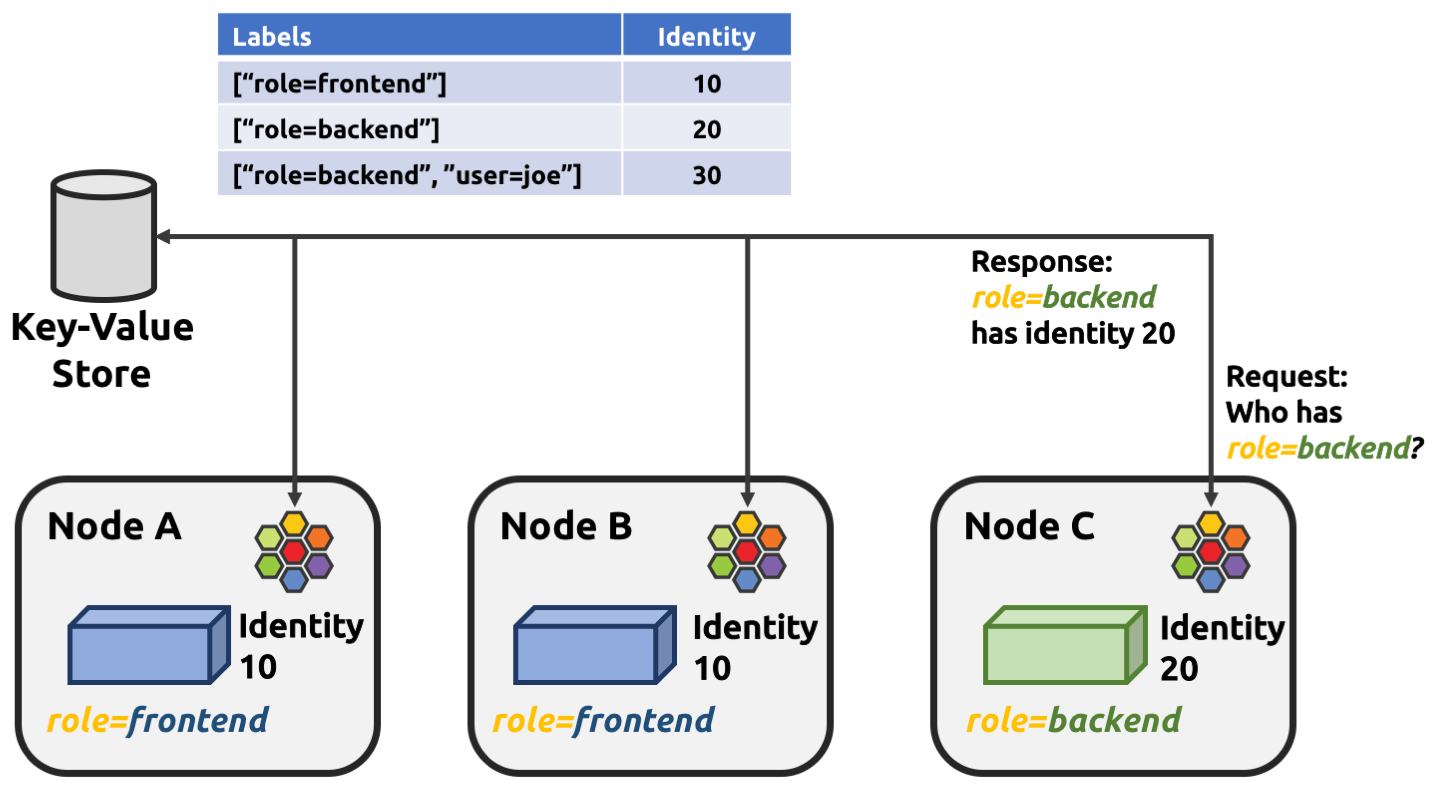
The operation to resolve an endpoint identity is performed with the help of the distributed key-value store which allows to perform atomic operations in the form generate a new unique identifier if the following value has not been seen before. This allows each cluster node to create the identity relevant subset of labels and then query the key-value store to derive the identity. Depending on whether the set of labels has been queried before, either a new identity will be created, or the identity of the initial query will be returned.
Node
Cilium refers to a node as an individual member of a cluster. Each node must be
running the cilium-agent and will operate in a mostly autonomous manner.
Synchronization of state between Cilium agents running on different nodes is
kept to a minimum for simplicity and scale. It occurs exclusively via the
Key-Value store or with packet metadata.
Node Address
Cilium will automatically detect the node’s IPv4 and IPv6 address. The detected
node address is printed out when the cilium-agent starts:
Local node-name: worker0
Node-IPv6: f00d::ac10:14:0:1
External-Node IPv4: 172.16.0.20
Internal-Node IPv4: 10.200.28.238