

Datapath Plugins
Warning
This is a feature for advanced users with deep knowledge of Cilium and its architecture. Be very sure you actually need this before using it, as you can break Cilium’s functionality or even compromise security. Use it at your own risk and know what you’re doing.
Note
This is a beta feature. Please provide feedback and file a GitHub issue if you experience any problems.
Datapath plugins let you inject your own BPF programs throughout the Cilium
datapath to influence datapath behavior or build custom observability tooling.
Datapath plugins are deployed as a DaemonSet and talk to Cilium agents via
a gRPC interface. Datapath plugins are intended primarily as means to enable
datapath extension for operators with advanced needs and advanced knowledge of
Cilium’s inner workings who are willing to continually maintain their plugin
as Cilium’s internal architecture evolves. They are not intended to enable an
ecosystem of third party off-the-shelf plugins and there are little to no
compatibility guarantees for datapath plugins between Cilium versions. With
that in mind, this guide will explore how datapath plugins work, what
capabilities they provide, and how to build and deploy one.
Overview
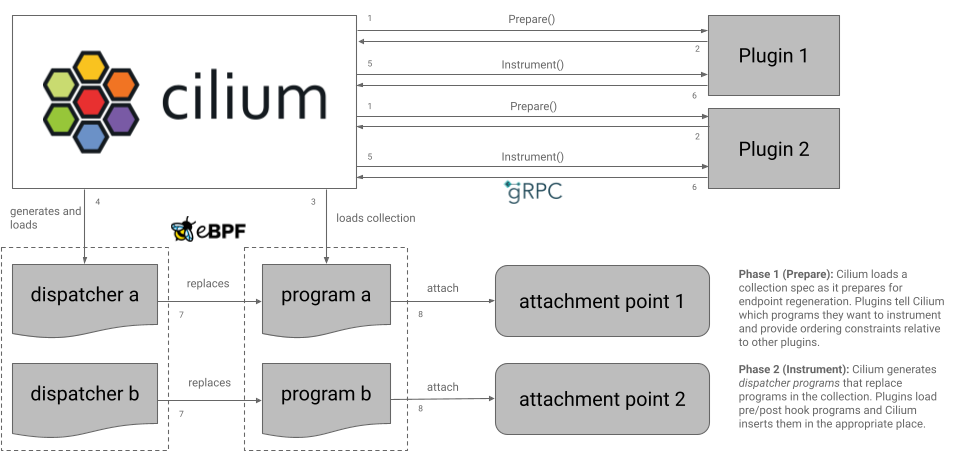
Datapath plugins are deployed as a DaemonSet. An instance of the plugin sits
on each node talking to the local Cilium agent via gRPC over a Unix domain
socket.
As Cilium is loading a BPF collection and preparing it for an attachment point or set of related attachment points it sends two rounds of gRPC requests to all registered plugins allowing them to instrument the collection with hooks that run before (pre) or after (post) programs in that collection. Plugins can attach hooks around TC, XDP, or cgroup SOCK_ADDR/SOCKET programs.
For now, only entrypoints are allowed to be instrumented, which are the top-level programs Cilium attaches to a BPF attachment point. This constraint may be loosened in the future to allow for more fine-grained instrumentation of the collection by a plugin.
After loading the collection spec but before loading the collection into the kernel, Cilium sends each plugin a
PrepareCollectionrequest containing all the context about the collection, the attachment point, and its configuration. Each plugin uses this information to determine which of Cilium’s programs (if any) it would like to instrument. ThePrepareCollectionresponse contains a list of pre or post program hooks that the plugin would like to inject. Each hook specification may contain a set of ordering constraints which express to Cilium that this particular hook must be placed before or after those of another plugin at that same hook point.After receiving all
PrepareCollectionresponses, if any plugin has indicated that it would like to inject a hook before or after some program in the collection, Cilium generates a dispatcher program in its place which invokes any pre hooks, invokes the original program, and finally invokes any post hooks. The dispatcher mechanism is covered in more detail below.Cilium loads the modified collection into the kernel.
Cilium creates an ephemeral request-specific directory in BPFFS to contain hook program pins for this load operation, e.g.
/sys/fs/bpf/cilium/operations/6a950f84-d8c0-468f-a8e5-c30545fd1ca5and maps each pre/post hook to a unique pin path within this directory. No pins are actually created at this point.Cilium sends an
InstrumentCollectionrequest to any plugin that provided a hook specification in the prepare phase. EachInstrumentCollectionrequest contains the same context about the collection and attachment point that was in the precedingPrepareCollectionrequest along with a list of hooks mirroring those requested by the plugin in itsPrepareCollectionresponse. Each hook contains an attach target providing all the context the plugin needs to load aBPF_PROG_TYPE_EXThook program into the kernel, and the uniquepin_pathfor this hook program that Cilium generated in the previous step.Each plugin loads hook programs and pins them to the designated pin paths before responding to the
InstrumentCollectionrequest.Cilium opens and unpins the hook programs then replaces the dispatcher subprograms with these programs creating a set of freplace links in their place.
With the collection finalized, Cilium attaches collection entrypoints to the relevant BPF attachment points in the kernel.
Enabling Datapath Plugins
helm install cilium ./cilium \
   --namespace kube-system \
   --set datapathPlugins.enabled=true
enable-datapath-plugins: true
Plugin Registration
To register a plugin with Cilium, create a CiliumDatapathPlugin resource:
apiVersion: cilium.io/v2alpha1
kind: CiliumDatapathPlugin
metadata:
  name: example
spec:
  attachmentPolicy: Always
  version: 0.0.1
The attachmentPolicy must be one of the following values:
Always: Cilium must be able to talk to the plugin to successfully load and attach any BPF collection. Plugin failures will cause Cilium to fail to reload BPF programs.BestEffort: If Cilium cannot talk to the plugin, Cilium will ignore the plugin and proceed to load BPF programs without the plugin.
Any time a CiliumDatapathPlugin is created, updated, or deleted Cilium triggers a full
datapath reinitialization. Bump the version string if you upgrade your
plugin and want Cilium to reinitialize; Cilium will not reinitialize the
datapath if your plugin’s pod shuts down or is replaced.
Talking To Cilium
Plugins must create a subdirectory that matches the name of their
CiliumDatapathPlugin resource under the configured
datapath-plugins-state-dir and listen on a Unix socket called
plugin.sock. For example, if your plugin’s name is “example” and
datapath-plugins-state-dir is /var/run/cilium/plugins, create a socket
at /var/run/cilium/plugins/example/plugin.sock and serve the
DatapathPlugin gRPC interface over it. Example:
unixSocketPath := "/var/run/cilium/plugins/example/plugin.sock"
// Clear out the old socket
os.Remove(unixSocketPath)
addr, err := net.ResolveUnixAddr("unix", unixSocketPath)
if err != nil {
        return fmt.Errorf("resolving address: %w", err)
}
listener, err := net.ListenUnix("unix", addr)
if err != nil {
        return fmt.Errorf("starting listener: %w", err)
}
server := grpc.NewServer()
datapathplugins.RegisterDatapathPluginServer(server, /* DatapathPluginServer implementation */)
server.Serve(listener)
Implementing The Server
The DatapathPlugin service defines two request types: PrepareCollection
and InstrumentCollection. PrepareCollection happens before the BPF
collection is loaded into the kernel. Cilium passes BPF collection details to
the plugin and the plugin tells Cilium how it would like to modify the
collection. InstrumentCollection happens after the BPF collection is loaded
into the kernel. Cilium passes BPF collection details to the plugin along with
details about hook attachment points it created in the prepare phase. The plugin
loads its BPF programs and passes them back to Cilium to be attached to these
hook points. See the full gRPC API listing below for details on the structure
of the request and response messages.
func (s *datapathPluginServer) PrepareCollection(ctx context.Context, req *datapathplugins.PrepareCollectionRequest) (*datapathplugins.PrepareCollectionResponse, error) {
    // Determine which programs in the collection to instrument and tell
    // Cilium in the PrepareCollectionResponse.
}

func (s *datapathPluginServer) InstrumentCollection(ctx context.Context, req *datapathplugins.InstrumentCollectionRequest) (*datapathplugins.InstrumentCollectionResponse, error) {
    // Load and pin BPF programs for each hook point specified in the
    // request. The set of hooks will match those passed to Cilium in the
    // associated PrepareCollection response.
}
Security Requirements
Cilium passes program and map IDs for the programs and maps in the collection
in the InstrumentCollection request. Depending on your plugin’s needs, you
may wish to pass these maps or programs to your own BPF collection as you
load your hooks. In order to get a BPF object ID from a file descriptor, you
must grant SYS_ADMIN to your plugin’s pod:
securityContext:
  capabilities:
    drop:
    - ALL
    add:
    # BPF ID -> FD translation requires CAP_SYS_ADMIN.
    - SYS_ADMIN
Such plugins run with root-equivalent privileges. It is the plugin developer’s responsibility to secure their plugin; a compromised plugin can result in a compromised cluster at a level similar to cluster admin.
Putting It All Together: Example Plugin
Cilium provides an example plugin that illustrates how to instrument each kind of collection and program. To deploy it, make sure that datapath plugins are enabled in your kind cluster then run the following commands:
$ make kind-image-datapath-plugin
$ make kind-install-cilium-datapath-plugin
Then confirm that the plugin is running and view its output:
$ kubectl get pods -n kube-system -l k8s-app=cilium-datapath-plugin
NAME                           READY   STATUS    RESTARTS   AGE
cilium-datapath-plugin-2rl8q   1/1     Running   0          51s
cilium-datapath-plugin-4dgr6   1/1     Running   0          51s
$ sudo cat /sys/kernel/debug/tracing/trace_pipe
<idle>-0       [014] ..s2. 2519176.160458: bpf_trace_printk: before host/eth0 cil_from_netdev()

ksoftirqd/6-36      [006] ..s1. 2519176.717678: bpf_trace_printk: before lxc/kube-system/coredns-6f6b679f8f-lvg99/lxcedad14d13632 cil_from_container()

ksoftirqd/6-36      [006] ..s1. 2519176.717703: bpf_trace_printk: after lxc/kube-system/coredns-6f6b679f8f-lvg99/lxcedad14d13632 cil_from_container() (ret=2)

cilium-operator-489770  [004] ..s2. 2519177.161817: bpf_trace_printk: before host/eth0 cil_from_netdev()

cilium-operator-489770  [004] ..s2. 2519177.161847: bpf_trace_printk: after host/eth0 cil_from_netdev() (ret=0)

...
The Dispatcher Mechanism And Interactions Between Plugins
Plugins can specify ordering constraints relative to other plugins on the same
hook point. Cilium uses these constraints to decide the relative order of plugin
hooks inside the dispatcher that it generates. PRE hooks run before the
original Cilium program while POST hooks run after the original Cilium
program.
Although Cilium generates the dispatcher dynamically, the logic looks like this:
int dispatch(void *ctx) {
    int orig_ret, ret;

    ret = __pre_hook_plugin_a__(ctx);
    if (ret != RET_PROCEED)
        return ret;
    ret = __pre_hook_plugin_b__(ctx);
    if (ret != RET_PROCEED)
        return ret;
    ...
    orig_ret = original_cilium_prog(ctx);
    ...
    ret = __post_hook_plugin_a__(ctx, orig_ret);
    if (ret != RET_PROCEED)
        return ret;
    ret = __post_hook_plugin_b__(ctx, orig_ret);
    if (ret != RET_PROCEED)
        return ret;

    return orig_ret;
}
Any plugin hook can stop the pipeline at any stage by returning any value other
than RET_PROCEED. The value of RET_PROCEED differs depending on the
type of program. For XDP and TC programs it’s -1 for everything else it’s 1.
It doesn’t matter if the original Cilium program or any of the hook programs tail call internally. Execution flow will always return to the dispatcher once the last tail call in the chain returns and its return value will be handed to the dispatcher. This works because each subprogram gets its own stack frame and tail calls only unwind the current stack frame.
Known Limitations
It is currently not possible to instrument programs that are intended to go into a
BPF_MAP_TYPE_PROG_ARRAYwhich excludes any programs except entrypoints likecil_to_container. This prevents Cilium from using freplace with such programs.
gRPC API Reference
- Datapath Plugins
- Table of Contents
- datapathplugins/datapathplugins.proto
- AttachmentContext
- AttachmentContext.Host
- AttachmentContext.InterfaceInfo
- AttachmentContext.LXC
- AttachmentContext.Overlay
- AttachmentContext.PodInfo
- AttachmentContext.Socket
- AttachmentContext.Wireguard
- AttachmentContext.XDP
- InstrumentCollectionRequest
- InstrumentCollectionRequest.Collection
- InstrumentCollectionRequest.Collection.Map
- InstrumentCollectionRequest.Collection.MapsEntry
- InstrumentCollectionRequest.Collection.Program
- InstrumentCollectionRequest.Collection.ProgramsEntry
- InstrumentCollectionRequest.Hook
- InstrumentCollectionRequest.Hook.AttachTarget
- InstrumentCollectionResponse
- PrepareCollectionRequest
- PrepareCollectionRequest.CollectionSpec
- PrepareCollectionRequest.CollectionSpec.MapSpec
- PrepareCollectionRequest.CollectionSpec.MapsEntry
- PrepareCollectionRequest.CollectionSpec.ProgramSpec
- PrepareCollectionRequest.CollectionSpec.ProgramsEntry
- PrepareCollectionResponse
- PrepareCollectionResponse.HookSpec
- PrepareCollectionResponse.HookSpec.OrderingConstraint
- HookType
- PrepareCollectionResponse.HookSpec.OrderingConstraint.Order
- DatapathPlugin
- Scalar Value Types